The mando-bass, has 4 single strings, rather than double courses, and it is tuned like a double bass. These were made by the Gibson company in the early twentieth century, but appear to have never been common. Most of the mandolin orchestras will prefer to use the ordinary double bass, rather than a specialized mandolin family instrument.
The piccolo or sopranino mandolin is a rare member of the mandolin family, tuned one octave above the tenor mandola and one fourth above the mandolin; the same relation as that of the piccolo or sopranino violin to the violin and viola. The instrument scale length is typically about 9.5 inches (240 mm).
Showing posts with label Drums. Show all posts
Showing posts with label Drums. Show all posts
Monday, June 30, 2008

Tuesday, June 10, 2008
Learn How To Read Guitar Tabs
If you are learning guitar you have probably heard about tablature, or tabs. As a new guitar player you are anxious to start playing songs, and you have been told that tabs are the easiest way to learn. That is good news. You do not need to spend weeks or months learning music theory.
Guitar tablature is a system of musical notation which is very popular with guitarists. With guitar tabs a composer can express most musical ideas on the acoustic or electric guitar in a clear, straightforward way.
If you want to start playing guitar right away, grab the tabs for your favorite song and take a look at what the tab consists of:
E---3------------------
B----------------------
G----------------------
D----------------------
A----------------------
E----------------------
You will probably believe me when I tell you that the tab is a representation of the neck of the guitar. You find out which frets to put your fingers at by following the numbers printed along the strings. If there is a number 3 on the top string, that means you put your finger at the third fret on the top E string - the thinnest string on the guitar. You have just played the note G. No problem. The guitar is your oyster.
Now let us move onto tabs for guitar chords. Here is an E Major chord:
E---0-------------------
B---0-------------------
G---1-------------------
D---2-------------------
A---2-------------------
E---0-------------------
Guitar tablature is a system of musical notation which is very popular with guitarists. With guitar tabs a composer can express most musical ideas on the acoustic or electric guitar in a clear, straightforward way.
If you want to start playing guitar right away, grab the tabs for your favorite song and take a look at what the tab consists of:
E---3------------------
B----------------------
G----------------------
D----------------------
A----------------------
E----------------------
You will probably believe me when I tell you that the tab is a representation of the neck of the guitar. You find out which frets to put your fingers at by following the numbers printed along the strings. If there is a number 3 on the top string, that means you put your finger at the third fret on the top E string - the thinnest string on the guitar. You have just played the note G. No problem. The guitar is your oyster.
Now let us move onto tabs for guitar chords. Here is an E Major chord:
E---0-------------------
B---0-------------------
G---1-------------------
D---2-------------------
A---2-------------------
E---0-------------------
 |  |  | |  | |  | |  | |  | | ||||||||||
| |||||||||||||||||||||
Friday, May 30, 2008
Learn How to Easily Read Guitar Tabs
With all those technical quarter notes and treble clefs, who really has time to learn guitar chords and riffs without spending days, weeks or even months taking private music lessons? Music notation is intimidating, but there is a simple solution to the problem – guitar tablature. Known as tab to professional musicians, it is almost like a diagram that shows guitarists exactly where to place their fingers. Tab presents amateurs and professionals alike with an easy way to learn new guitar chords or even a complete song. Let’s break down the basics.
Where to begin with guitar tabs
Think of it this way - if you can read a map, then you can also learn guitar chords from tab. Tab consists of six horizontal lines, representing the strings of the guitar (similar to a guitar chord chart, only sideways). The low E string is represented by the bottom line, and the other strings follow in succession the highest E. Players simply follow symbols on the lines indicating what string should be pushed, and in what location (fret). For example, if the number one appears on the top line, it indicates that a finger should be placed on the highest guitar string, in the first fret. When multiple numbers appear simultaneously, it indicates that certain strings should be pushed at the same time, in the fret indicated by the numbers provided.
Taking guitar tabs to the next musical level
Most tab will indicate the chord symbol above the lines and fret numbers, so that more advanced players can read along with what they already know. Advanced tab notation may consist of complex instructions from the author. For example, sometimes a guitarist will slap their finger down forcefully on top of a string, creating a different sound. This technique, known as a hammer-on, is often indicated by appearance of the letter h in tab.
Unfortunately, tab does not have a set of standardized rules, and there are many variations. There is also little direction for rhythm and timing, but it will work well for musicians who have a good ear, and a preexisting idea about how something is supposed to sound before they play it. It is best to start by picking out a well known, simple folk melody that is easily identifiable, and then move on to more complex patterns including chords and riffs.
Guitar tabs for every musician
Tab is not only an excellent way to learn new guitar chords; it is also used to notate scales, riffs, or entire songs. Guitarists who wish to try their hand with classical pieces, but do not read standard notation can experience the joy of tackling and mastering challenging pieces. Many publishers create albums of classical pieces which include standard notation, chords, and tab. Every genre is available in tab on the Internet or for purchase in a music store.
One of the greatest aspects of tab is that once you learn how to read it, the notation can be applied to many stringed instruments like the mandolin or bass. The possibilities for a blossoming musician are endless with this simple system. From chord charts to power ballads and sonatas, tab will expand your repertoire to include an unlimited number of pieces.
For advice on how to select the perfect drum set, cymbal, conga, bongos, djembe, acoustic guitar, electric guitar or other musical product, please see our Buyer's Guide and Advice pages.
Where to begin with guitar tabs
Think of it this way - if you can read a map, then you can also learn guitar chords from tab. Tab consists of six horizontal lines, representing the strings of the guitar (similar to a guitar chord chart, only sideways). The low E string is represented by the bottom line, and the other strings follow in succession the highest E. Players simply follow symbols on the lines indicating what string should be pushed, and in what location (fret). For example, if the number one appears on the top line, it indicates that a finger should be placed on the highest guitar string, in the first fret. When multiple numbers appear simultaneously, it indicates that certain strings should be pushed at the same time, in the fret indicated by the numbers provided.
Taking guitar tabs to the next musical level
Most tab will indicate the chord symbol above the lines and fret numbers, so that more advanced players can read along with what they already know. Advanced tab notation may consist of complex instructions from the author. For example, sometimes a guitarist will slap their finger down forcefully on top of a string, creating a different sound. This technique, known as a hammer-on, is often indicated by appearance of the letter h in tab.
Unfortunately, tab does not have a set of standardized rules, and there are many variations. There is also little direction for rhythm and timing, but it will work well for musicians who have a good ear, and a preexisting idea about how something is supposed to sound before they play it. It is best to start by picking out a well known, simple folk melody that is easily identifiable, and then move on to more complex patterns including chords and riffs.
Guitar tabs for every musician
Tab is not only an excellent way to learn new guitar chords; it is also used to notate scales, riffs, or entire songs. Guitarists who wish to try their hand with classical pieces, but do not read standard notation can experience the joy of tackling and mastering challenging pieces. Many publishers create albums of classical pieces which include standard notation, chords, and tab. Every genre is available in tab on the Internet or for purchase in a music store.
One of the greatest aspects of tab is that once you learn how to read it, the notation can be applied to many stringed instruments like the mandolin or bass. The possibilities for a blossoming musician are endless with this simple system. From chord charts to power ballads and sonatas, tab will expand your repertoire to include an unlimited number of pieces.
For advice on how to select the perfect drum set, cymbal, conga, bongos, djembe, acoustic guitar, electric guitar or other musical product, please see our Buyer's Guide and Advice pages.
Tuesday, May 27, 2008
Learn To Play Musical Instrument
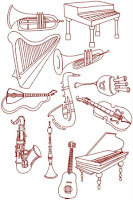
If you want to learn a musical instrument, you are in luck. There is a vast variety of musical instruments which can be learned easily and at low cost with the help of the scores of music instruments available. However, if you are a beginner, you may get confused by the array of choices. You may worry about which instrument to choose, how much time the lessons will take, the costs and many other factors. This article will guide you on the correct selection of the instrument so that you may not have to regret your choice later.
First of all consider your interest which is of course what will keep you to the end of the lessons. Unless you are interested in the instrument you are trying to learn, you will never really master it. So think about the type of music and instrument you like. Check out different options and pick the one you feel is best for you.
Next point to consider is the cost. It is possible that the music you want to learn is too costly for you. May be the instrument costs a ton or the tuitions are too expensive. Thus, try to select one that suits your budget. Also, consider taking tuitions that are offered in groups in order to reduce costs. If money is not a factor, you could opt for private tuitions that can offer you a lot of flexibility in timings.
Another thing to consider is the amount of time the lessons take. If you have a time crunch or are not a patient sort, you may not be able to finish learning a difficult musical instrument. There is no short cut to learning music. You may have to work very hard to be able to understand and work with any new instrument.
You must be really involved in the training and be enthusiastic. You may not grasp the ABCs of the musical instrument immediately, so you need to be patient. Also, expose yourself to a lot of recordings by good players. You could also do the home recording of your own music to check on your progress.
An important point could be the physical restrictions that certain musical instruments pose. If you are small, you may find certain musical instruments too heavy. Also, certain instruments require longer fingers or other such natural characteristics. Usually, the music teacher will be able to judge and guide you on proper selection. You could also borrow an instrument from an acquaintance to check how well you could do with it.
Monday, May 19, 2008
Know Your Pearl Drums Better
Drums are one of the most popular of musical instruments. Drummers all over the world have been making the effort to create a drum set that would truly suit the appetite of music lovers all over the world. One of the primary characteristics of a drum is that it can produce indefinite low and high-pitched sounds constantly.
Pearl rock was based on anti-establishment rock music genre in the mid 70s,The pearl drummers made a name for them with playing with the shorter version of the rock. The right pearl drum kit gear depends on features like playing style, personal penchant, monetary funds, and moving options of the drummer. The hardware part was constituted by the cymbals and tom-tom stands and was considered an integrated part of the base drum kit. Drums and cymbals are considered the breakable part of the collection as it goes through rigorous wear and tear.
One or two electric guitars, an electric bass, a drum kit, the vocals constitute the distinctive punk rock instrumentation. During the mid 1970s people who did not have too much ability in music tried to express themselves through the new form of rock music. The anti institutional based drumming was quick to catch the attention of the public.
Punk drummers like to change their tuning with particular music intervals. This makes the distance between the tuned notes of one drum with the other consistent. As it is not based on any chromatic notes so the punk drummers can have any start point with the punk drums. Although there are many tuning opinions, the bulk of them revolve around the major chords. In addition, the time factor for the whole music length was shorter than the regular rock so the start with the punk drums was fast.
A drum key or a similar kind of device is used to tune the drum set. The tension of a drumhead is changed to tune it. The difference in tuning between same elements of a drum kit and other percussion element is quite significant. Punk drums are no different.
Alternating with the hi-hat cymbals will help you keep the speed but make sure you are not changing the beats. You can create interesting fills with fast music. Listening to good drummers will help you in building your own creative ways. One of the chief ingredients of the punk music is energy, so beating the punk drums with vigor would help in being attuned with the speed of the music.
Live Music - Browse the LMFM listings and check out featured artists, live gig reviews and recommended live bands and artists playing near you in the UK and Ireland.
Pearl rock was based on anti-establishment rock music genre in the mid 70s,The pearl drummers made a name for them with playing with the shorter version of the rock. The right pearl drum kit gear depends on features like playing style, personal penchant, monetary funds, and moving options of the drummer. The hardware part was constituted by the cymbals and tom-tom stands and was considered an integrated part of the base drum kit. Drums and cymbals are considered the breakable part of the collection as it goes through rigorous wear and tear.
One or two electric guitars, an electric bass, a drum kit, the vocals constitute the distinctive punk rock instrumentation. During the mid 1970s people who did not have too much ability in music tried to express themselves through the new form of rock music. The anti institutional based drumming was quick to catch the attention of the public.
Punk drummers like to change their tuning with particular music intervals. This makes the distance between the tuned notes of one drum with the other consistent. As it is not based on any chromatic notes so the punk drummers can have any start point with the punk drums. Although there are many tuning opinions, the bulk of them revolve around the major chords. In addition, the time factor for the whole music length was shorter than the regular rock so the start with the punk drums was fast.
A drum key or a similar kind of device is used to tune the drum set. The tension of a drumhead is changed to tune it. The difference in tuning between same elements of a drum kit and other percussion element is quite significant. Punk drums are no different.
Alternating with the hi-hat cymbals will help you keep the speed but make sure you are not changing the beats. You can create interesting fills with fast music. Listening to good drummers will help you in building your own creative ways. One of the chief ingredients of the punk music is energy, so beating the punk drums with vigor would help in being attuned with the speed of the music.
Live Music - Browse the LMFM listings and check out featured artists, live gig reviews and recommended live bands and artists playing near you in the UK and Ireland.
Tuesday, April 8, 2008
How To Learn To Play Piano
Though learning piano is a dream for many people for years, deciding to learn and learning wouldn't happen just like that. Luckily, some tools are provided by the technology and this makes it easier than ever to learn the piano even in the busy schedule of our lives. An offline lesson occasionally maybe needed or not along with your online learning materials according to your style of learning. It can be pleasing and beneficial in the growth and restoration of the mind, though learning piano may be difficult at an elder age.
Today, online courses on the internet have come as a great source to people who want to learn piano without leaving the comfort of their home. So you need not surprise if there are a number of piano aspirants moving on to the internet for courses on piano learning. And for the people who have patience, commitment and the money for those CD courses which are costlier, this is a great alternative. However, what about those people who want to learn piano in their style and their own conditions? It would be great if there were websites that provide piano learning aspirants with knowledge they needed to expertise the piano without overstressing them. Fortunately, there are sites which help you learn the piano in your own style, but there are only a few of them. Hence, you really need to research, particularly when many websites try to take your money and leave you disturbed without making you learn any skills.
It would be great if you find such a website, and you can learn playing tunes on the first day itself without any difficulty even if you have not touched a piano key before. And it is possible as there is no reason for you to get surprised by the greatness of this instrument. Nevertheless, a piano keyboard is just a row of buttons, and if you can push buttons, you can create music easily. Therefore, the great determination to make music and being well on your way to become a pianist is what are all really needed.
Sometimes, as people were told that to learn piano one needs to put a lot of hard work, they used to withdraw themselves from trying to learn piano. Now, this wasn't actually untrue some years back, as there were terribly painful exercises to be played by students and learn songs they didn't like for the preparation of the songs which were fearful. In other way, learning piano was made an unpleasing and boring task in those days. Now a days, easy to understand and visual cues and "tricks" have replaced the boring lessons in books, which is a complete contrast to the older ways of learning. With some practical changes like these, learning piano has become so easy and enjoyable than it was.
On the other hand, along with beginners, even qualified performers can take the advantage from the vast piano learning opportunities out there. So if you know the basics already and want to easily play the keys and tones very well, you need not worry, because, if you believe it or not, now you can get a way to many hidden secrets on learning how to play keys and play piano as your favorite musicians do.
Today, online courses on the internet have come as a great source to people who want to learn piano without leaving the comfort of their home. So you need not surprise if there are a number of piano aspirants moving on to the internet for courses on piano learning. And for the people who have patience, commitment and the money for those CD courses which are costlier, this is a great alternative. However, what about those people who want to learn piano in their style and their own conditions? It would be great if there were websites that provide piano learning aspirants with knowledge they needed to expertise the piano without overstressing them. Fortunately, there are sites which help you learn the piano in your own style, but there are only a few of them. Hence, you really need to research, particularly when many websites try to take your money and leave you disturbed without making you learn any skills.
It would be great if you find such a website, and you can learn playing tunes on the first day itself without any difficulty even if you have not touched a piano key before. And it is possible as there is no reason for you to get surprised by the greatness of this instrument. Nevertheless, a piano keyboard is just a row of buttons, and if you can push buttons, you can create music easily. Therefore, the great determination to make music and being well on your way to become a pianist is what are all really needed.
Sometimes, as people were told that to learn piano one needs to put a lot of hard work, they used to withdraw themselves from trying to learn piano. Now, this wasn't actually untrue some years back, as there were terribly painful exercises to be played by students and learn songs they didn't like for the preparation of the songs which were fearful. In other way, learning piano was made an unpleasing and boring task in those days. Now a days, easy to understand and visual cues and "tricks" have replaced the boring lessons in books, which is a complete contrast to the older ways of learning. With some practical changes like these, learning piano has become so easy and enjoyable than it was.
On the other hand, along with beginners, even qualified performers can take the advantage from the vast piano learning opportunities out there. So if you know the basics already and want to easily play the keys and tones very well, you need not worry, because, if you believe it or not, now you can get a way to many hidden secrets on learning how to play keys and play piano as your favorite musicians do.
Tuesday, April 1, 2008
Snare Drum
Analog synthesizers have regained some degree of popularity in recent years, as electronic dance music has become more widespread and successful. Although analog technology has become replaced by cheaper digital modeling technology with more features, the goal of VA (virtual analog) synthesis is to be able to recreate the warmth and nuances of the highly variable analog circuits of yesteryear. The ability of digital components to accurately model is the subject of great debate and beyond the scope of this article, but a general consensus is maintained that they are becoming more and more difficult to tell the difference between.
With that in mind, the assumptions that this article works under include the following: That you possess an analog or virtual analog synthesizer with at least one oscillator (VCO), a low pass filter with resonance (LPF) and key tracking (also called key follow on some models), one or more standard ADSR-type envelope generators (EG) that can be routed to affect amplitude, filter cutoff frequency, and preferably pitch, and a white noise source. Even with such a relatively limited palate of sound-sculpting tools, a large number of exciting sounds can be achieved.
Furthermore, these articles will make the following assumptions about the default settings (an initialized patch, if you will) of your synth in the interest of consistency. First, the oscillator footage (or octave) should be an intermediate setting (16' or 8'). The filter should be wide open (all the way up so as to let all sound pass through unaffected) with no resonance. The envelope(s) should have zero attack, decay, and relase with %100 sustain. With these parameters adjusted to the preceding values, most basic synth sounds can be easily realized.
In this article we will examine classic analog percussion sounds similar to the drum machines and synths of the 80's through modern techno and house music. Let's start with a basic snare-type sound. Use a relatively mellow waveform such as a triangle wave, blended with however much white noise is appropriate to your ears. The key here is to find a good ratio between the sound of the shell of a snare drum (the oscillator) and the crack of the "drum head," which is approximated with noise. Keep the filter open for now. Set the amp envelope to have zero attack and sustain and quick decay (a third or less) with a little bit of release. These parameters can be adjusted, depending on whether you are going for a more or less realistic sound.
This should put you comfortably within the realm of the classic Roland drum machines of the 80's, which used ringing oscillators excited by a noise source to achieve their classic sound. For a more Kraftwerk-esque thwipp-type snare, use the filter in conjuntion with an envelope with similar parameters to the amplifier EG. Set the filter cutoff frequency fairly low with resonance to taste (try at every setting, but watch your speakers and ears at high resonance settings!). Use a healthy amount of envelope modulation to keep the transient bright, with a more muted decay. Now you can make some sweet synth-pop snares.
Wednesday, March 12, 2008
Snare Drum Buying Guide
The snare drum contains:
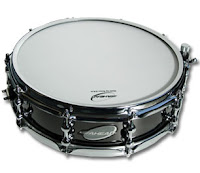
A shell or circular body. A top "batter" head and a bottom ultra-thin clear head. Chrome hoops (rims) that fasten the heads to the shell. Tension rods that screw into lug casings, these are used to tighten the rim onto the shell. Snare wires. A throw-off apparatus.
Whatever drum you buy make certain that the snare (thin metal strings on the bottom of the drum) are intact and that the throw-off lever on the side of the drum works properly. The throw-off is a chrome apparatus found on the side or the shell of the snare drum. It contains a lever that snaps the snare wires up against the bottom drumhead or releases them so that they hang about 1/8" below the head. When the throw-off or strainer is in the up position, you will hear the buzz of the snare wires. When the throw-off is in the sideways position, the drum will sound similar to a high-pitched tom-tom.
Tom-toms are similar to snare drums in that they have two heads fastened to a shell. They do not contain snare wires though. They also differ from the snare drum in their function. When checking the snare strainer, make sure that you can turn the snares on and off without too much effort. Also, make sure that the snares tighten and release quietly. If you do not get this on-off effect at all, it may simply mean that the snare wires are too loose. All quality snare drums have an adjustment knob that is part of the throw-off apparatus. If the snare is not working properly, try tightening this knob. You should feel the tension increase depending on the direction you turn it. If you turn the knob and it has no effect on the sound of the drum, chances are the apparatus is faulty. Don't buy this drum.
Finally-and this goes for any drum-check to see if the drum has any cracks in the shell and make sure that the rims or hoops that fasten the head to the shell are not bent or dented. Also, make sure that none of the tension rods (screws) are missing, and check that none of the lugs(tension rod casings) are stripped. Don't worry about heads, because these are dispensable. Often the head that comes with your purchase needs replacing anyway. Once upon a time, drumheads were made from calf hides (skin). However, the problem with skins was that they were very difficult to keep in tune due to fluctuations in the weather. They were also not very durable. Now days, we use plastic or Mylar heads on our drums and the most popular head manufacturer is Remo, although Evans and Aquarian make fine heads, too. On the bottom of your snare drum, you must use an ultra-thin clear head. Anything thicker will choke the snare wires and they will not vibrate. Also, you should use only a single-ply "batter" head on the top of your snare drum. The batter head is a rough, sand papery-surfaced head that is designed to give texture to brush strokes. If the head were smooth, brush-ing the head would have little effect. The batter head is also single-ply to allow for a crisper tone and more sustain.
A shell or circular body. A top "batter" head and a bottom ultra-thin clear head. Chrome hoops (rims) that fasten the heads to the shell. Tension rods that screw into lug casings, these are used to tighten the rim onto the shell. Snare wires. A throw-off apparatus.
Whatever drum you buy make certain that the snare (thin metal strings on the bottom of the drum) are intact and that the throw-off lever on the side of the drum works properly. The throw-off is a chrome apparatus found on the side or the shell of the snare drum. It contains a lever that snaps the snare wires up against the bottom drumhead or releases them so that they hang about 1/8" below the head. When the throw-off or strainer is in the up position, you will hear the buzz of the snare wires. When the throw-off is in the sideways position, the drum will sound similar to a high-pitched tom-tom.
Tom-toms are similar to snare drums in that they have two heads fastened to a shell. They do not contain snare wires though. They also differ from the snare drum in their function. When checking the snare strainer, make sure that you can turn the snares on and off without too much effort. Also, make sure that the snares tighten and release quietly. If you do not get this on-off effect at all, it may simply mean that the snare wires are too loose. All quality snare drums have an adjustment knob that is part of the throw-off apparatus. If the snare is not working properly, try tightening this knob. You should feel the tension increase depending on the direction you turn it. If you turn the knob and it has no effect on the sound of the drum, chances are the apparatus is faulty. Don't buy this drum.
Finally-and this goes for any drum-check to see if the drum has any cracks in the shell and make sure that the rims or hoops that fasten the head to the shell are not bent or dented. Also, make sure that none of the tension rods (screws) are missing, and check that none of the lugs(tension rod casings) are stripped. Don't worry about heads, because these are dispensable. Often the head that comes with your purchase needs replacing anyway. Once upon a time, drumheads were made from calf hides (skin). However, the problem with skins was that they were very difficult to keep in tune due to fluctuations in the weather. They were also not very durable. Now days, we use plastic or Mylar heads on our drums and the most popular head manufacturer is Remo, although Evans and Aquarian make fine heads, too. On the bottom of your snare drum, you must use an ultra-thin clear head. Anything thicker will choke the snare wires and they will not vibrate. Also, you should use only a single-ply "batter" head on the top of your snare drum. The batter head is a rough, sand papery-surfaced head that is designed to give texture to brush strokes. If the head were smooth, brush-ing the head would have little effect. The batter head is also single-ply to allow for a crisper tone and more sustain.
Monday, March 3, 2008
Development of Steel Drums

Earlier the Musical instruments were devised by cutting varying lengths of bamboos. A by product of cultural gaps between the rich and the poor, steel drums have emerged with the musical quality of both the classes.
The early 1930s saw a great evolution in the history of steel drums with metal beating drums. The first pitched metal drum was made out of small metal containers, which were convex in shape. But with time it evolved to a great extent and now it is constructed from a 55 gallon barrel. Steel drums are a recently re-invented addition to the world of musical instruments.
Steel pan music reached new heights in the 19th century when a steel band got the opportunity to perform in common wealth celebrations. This gave steel drummers a new international exposure and gradually it became an established art form, revered by music lovers across the world. Steel drummers are adapting themselves in a varied number of ways to suit different tastes.
Instrumental music can broadly be categorized into the following types
With steel drums you can churn out almost everything ranging from buoyant pop tunes to hip hop music. Steel drums can churn out almost every type of music old, straight, alternative, orthodox as well as modern.
Characteristics of steel drums
The early 1930s saw a great evolution in the history of steel drums with metal beating drums. The first pitched metal drum was made out of small metal containers, which were convex in shape. But with time it evolved to a great extent and now it is constructed from a 55 gallon barrel. Steel drums are a recently re-invented addition to the world of musical instruments.
Steel pan music reached new heights in the 19th century when a steel band got the opportunity to perform in common wealth celebrations. This gave steel drummers a new international exposure and gradually it became an established art form, revered by music lovers across the world. Steel drummers are adapting themselves in a varied number of ways to suit different tastes.
Instrumental music can broadly be categorized into the following types
Vocal supported instrumental music
Western instrumental music
Oriental classical music
Instrumental music has been very popular from ancient times. The different traditions of instrumental music have been as followed .
Andalusian classical musicThe world of music is full of fun and thrills. So, be ready to sway every heart and soul with the lilting tunes of steel drums that are definitely going to jazz up the musical world.
Arab classical music
Gagaku, Gamelan
Classical Korean
With steel drums you can churn out almost everything ranging from buoyant pop tunes to hip hop music. Steel drums can churn out almost every type of music old, straight, alternative, orthodox as well as modern.
Characteristics of steel drums
Steel drums generally have a very high tempo.Steel drum beats can actually transport you to a new different world of music and acts as a rebellion against established social norms. It can cast a hypnotic spell on its listeners.
It follows repetitious beats.
Steel drums are a product of western cultural scenario.
It produces high decibel sound.
It provides greater versatility to drummers.
It is capable of producing chromatic range of notes and tones.
Friday, February 29, 2008
10 Greatest Movies Of All Time
After hundreds of movies, thousands of eye-popping fight scenes and millions of punches thrown...which ones are the best? Which ones have I been missing out on my whole life? Which ones must I have in my collection in order to not bring shame upon my family name?
We’ve scoured the internet. Reviews. Forums. Amazon. Postings. Bulletins. And this list is what we’ve come up with as the greatest Kung-Fu movies of all time and why you should watch each one. Pay attention to movies involving Yuen Wo-Ping as either director or action director, there's a reason why half this list is movies where he was involved!
If you want to watch trailers of these movies, go to:
#1 - Way of the Dragon (1979)
#2 - Shaolin Temple (1982)
#3 - Ong Bak (2003)
#4 - Iron Monkey (1993)
#5 - 5 Deadly Venoms (1978)
#6 - The Seven Samurai (1954)
#7 - Legend of Drunken Master (1994)
#8 - Crouching Tiger Hidden Dragon (2000)
#9 - Kill Bill vol. 1 (2003)
#10 - Fist of Legend (1994)
We’ve scoured the internet. Reviews. Forums. Amazon. Postings. Bulletins. And this list is what we’ve come up with as the greatest Kung-Fu movies of all time and why you should watch each one. Pay attention to movies involving Yuen Wo-Ping as either director or action director, there's a reason why half this list is movies where he was involved!
If you want to watch trailers of these movies, go to:
#1 - Way of the Dragon (1979)
#2 - Shaolin Temple (1982)
#3 - Ong Bak (2003)
#4 - Iron Monkey (1993)
#5 - 5 Deadly Venoms (1978)
#6 - The Seven Samurai (1954)
#7 - Legend of Drunken Master (1994)
#8 - Crouching Tiger Hidden Dragon (2000)
#9 - Kill Bill vol. 1 (2003)
#10 - Fist of Legend (1994)
By:- Javier Lozano, Jr.
Visit:- Discount musical instruments
Friday, February 22, 2008
Purchasing Drum - TIps & Tricks
If you purchase a full drum set, don't be concerned with getting a full array of tom-toms, cymbals, and other accessories. A simple four-piece will suffice. Rack tom-toms are mounted on top of the bass drum, floor toms stand on the floor supported by three metal legs.
Also, don't forget the hi-hats and stand, bass drum pedal, and padded throne or drum stool. Finally for beginners, cases are optional since you will not be traveling all over town, night after night, with your gear. If you do buy cases, Humes & Berg makes easy to use nylon padded bags. They call them Tuxedo cases. In summary, do not to be fooled by beautiful, sparkly new drums and cymbals, since this can be misleading. As you may have guessed by now, used drums and cymbals should not, in any way, be looked down upon. In fact, many in-the-know drummers enjoy scouting for rare and used equipment, and revel in stories of how they found some great snare drum or cymbal tucked away in the bargain bin at a pawn shop, tag sale, or even large retail outlet. So, take your time and find equipment that will keep you satisfied for at least a few years.
Climate control is essential to the health of your drums and cymbals. Extreme cold can cause shell veneers to peel off and crack. Consistent contact with moisture can also cause the brass on cymbals and the chrome on drums to rust.
Buying the Right Accessories
Buying the right gear is extremely important. Having the most expensive or fancy equipment is not. As you begin to define your goals and solidify your musical interests, you will be able to make better decisions about what drums, cymbals, hardware, sticks, pads, and other equipment you will want to use for practice. You may even begin to think about what your dream drum set might be. At this stage of the game, however, it is important not to become overly preoccupied with equipment. You will want to make smart purchases, but don't get caught up in a retail frenzy, or you will only waste your money.
Drum Pads
Drum pads are an essential part of every drummer's collection. Beginners often can't afford drums themselves, so pads take on even more relevance. As of this writing, the best pad on the market is the gum rubber Real Feel drum pad. This pad will give you the necessary bounce you need to develop good technique. The Remo Drum Company also makes fine pads and pad drum sets, though they are a little loud. If neither pad is available, ask the clerk at your local music store which pads offer great stick rebound and a quiet surface. Since drums themselves can be very loud, the pad offers a wondet-ful alternative to supplying earplugs for your entire neighborhood.
MP3 Mobile Phones - Buy latest music phones from sony ericsson, nokia, samsung, lg and other brands. Walkman phones, Nseries music series phones and many more handsets are available.
Also, don't forget the hi-hats and stand, bass drum pedal, and padded throne or drum stool. Finally for beginners, cases are optional since you will not be traveling all over town, night after night, with your gear. If you do buy cases, Humes & Berg makes easy to use nylon padded bags. They call them Tuxedo cases. In summary, do not to be fooled by beautiful, sparkly new drums and cymbals, since this can be misleading. As you may have guessed by now, used drums and cymbals should not, in any way, be looked down upon. In fact, many in-the-know drummers enjoy scouting for rare and used equipment, and revel in stories of how they found some great snare drum or cymbal tucked away in the bargain bin at a pawn shop, tag sale, or even large retail outlet. So, take your time and find equipment that will keep you satisfied for at least a few years.
Climate control is essential to the health of your drums and cymbals. Extreme cold can cause shell veneers to peel off and crack. Consistent contact with moisture can also cause the brass on cymbals and the chrome on drums to rust.
Buying the Right Accessories
Buying the right gear is extremely important. Having the most expensive or fancy equipment is not. As you begin to define your goals and solidify your musical interests, you will be able to make better decisions about what drums, cymbals, hardware, sticks, pads, and other equipment you will want to use for practice. You may even begin to think about what your dream drum set might be. At this stage of the game, however, it is important not to become overly preoccupied with equipment. You will want to make smart purchases, but don't get caught up in a retail frenzy, or you will only waste your money.
Drum Pads
Drum pads are an essential part of every drummer's collection. Beginners often can't afford drums themselves, so pads take on even more relevance. As of this writing, the best pad on the market is the gum rubber Real Feel drum pad. This pad will give you the necessary bounce you need to develop good technique. The Remo Drum Company also makes fine pads and pad drum sets, though they are a little loud. If neither pad is available, ask the clerk at your local music store which pads offer great stick rebound and a quiet surface. Since drums themselves can be very loud, the pad offers a wondet-ful alternative to supplying earplugs for your entire neighborhood.
MP3 Mobile Phones - Buy latest music phones from sony ericsson, nokia, samsung, lg and other brands. Walkman phones, Nseries music series phones and many more handsets are available.
Subscribe to:
Posts (Atom)